The Hidden Rules Behind Japan’s Urban Order and Taiwan’s Urban Friction
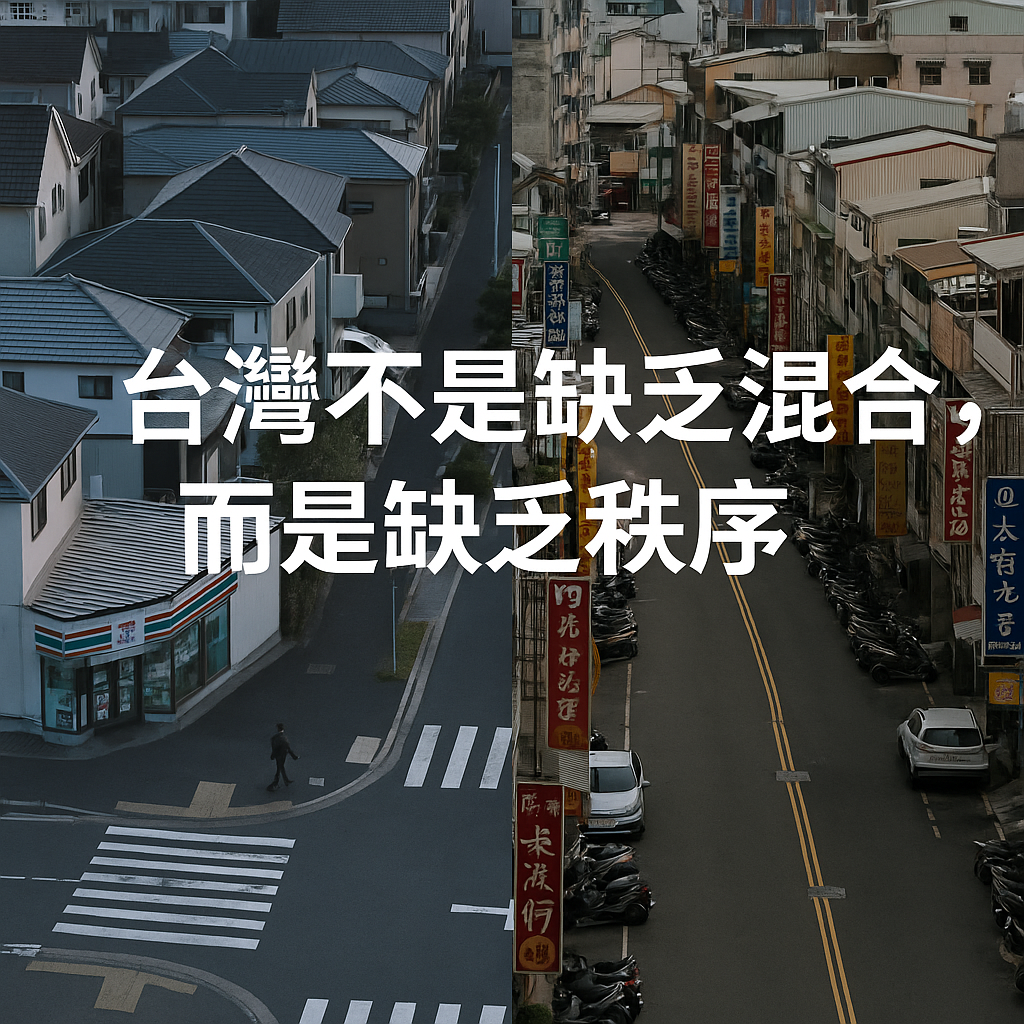
Walk through a Tokyo neighborhood and you will see barber shops, homes, cafes, and clinics standing side by side. Even at very high density, the streets remain clean and legible. In Taipei, similar scenes often feel crowded and chaotic. The difference is not just about development stage, but about institutions, culture, and economic logic.
- Hank
- 7 min read
English Version (中文版本在下方)
The following article was produced in collaboration with AI.
Walk through a Tokyo neighborhood and you will see barber shops, homes, cafes, and clinics standing side by side. Even at very high density, the streets remain clean and legible. Daily life and commerce are tightly interwoven without constantly getting in each other’s way.
In Taipei, similar streets often feel crowded and chaotic. Restaurants, cram schools, and karaoke venues appear inside residential areas. Scooters fill the arcades. Power lines hang across the sky. This is not just a difference in development stage. It is the result of institutions, culture, and economic logic colliding with one another.
Japanese cities represent an intentionally designed form of coexistence. Taiwanese cities, by contrast, often reflect what happens when freedom of use collides without enough coordination.
1. Different Institutional Starting Points: Japan Allows Mixed Use by Design, Taiwan Forbids It and Then Makes Exceptions
Japan’s zoning system begins with the assumption that city life cannot be neatly split into pure-use districts. The government does not manage space primarily by “use type” but by externalities. If noise, traffic, and waste can be controlled, then commercial activity is allowed inside residential areas. Convenience stores, cafes, and clinics appearing in neighborhoods are not exceptions. They are the direct result of the system.
That flexibility allows urban life to form its own rhythm without requiring endless after-the-fact fixes.
Taiwan, by contrast, still operates with a planning logic inherited from the Japanese colonial era, one that assumes residential zones should not contain commercial activity. But as the economy changed, real life outgrew those rigid categories. The government now relies on approvals, special permissions, and ad hoc adjustments, turning exceptions into the norm.
The gap between law and daily life keeps widening, producing a governance environment that is strict in theory but disorderly in practice. Over time, the gray zone becomes both the lubricant of the Taiwanese city and the source of its chaos.
2. Tax Structure and Market Incentives: Land Worship Pushes Space Out of Control
In Japan, buildings depreciate quickly and the tax system encourages rebuilding. Old structures become an economic burden if they are not renewed. Buildings are treated almost like consumables, while land remains the real asset. This gives cities room to adjust themselves as populations and needs change.
Taiwan’s tax logic is almost the opposite.
Buildings depreciate slowly, holding taxes are low, and land prices keep rising. That turns old buildings into stores of value rather than assets waiting to be renewed. Owners have little incentive to rebuild. Instead, they often maximize returns by renting out ground floors for commercial use. Upper-floor residents absorb the noise and traffic, but lack meaningful institutional protection.
As a result, urban space is no longer allocated according to functional needs. It is shaped by land price and return on investment. When everyone behaves rationally within market logic, but the system provides no coordination mechanism, the outcome is a city that looks prosperous on the surface while becoming disordered inside.
3. A Difference in Cultural DNA, Part One: Japan Runs on Order, Taiwan Runs on Tolerance
Beyond institutions, the deeper cultural logic matters just as much. Japanese urban life depends heavily on social self-discipline. The culture of avoiding meiwaku, causing trouble to others, pushes both residents and businesses to actively protect public order by controlling noise, maintaining cleanliness, and respecting operating hours.
Neighborhoods also contain many informal rules: greeting one another, cooperating during festivals, and self-governing local shopping streets. These cultural mechanisms help high-density urban areas remain harmonious.
Taiwan, by contrast, often relies on a culture of private entitlement and endurance. Land is seen as an extension of individual rights. Trust and negotiation between neighbors are weaker. Faced with illegal additions, noise, or illegal parking, many people simply choose to let it go.
On the surface, that tolerance can make the city feel lively and diverse. In practice, it leaves public order in a vacuum with no one truly maintaining it. Japanese neighborhoods stay balanced through order and manners. Taiwanese neighborhoods keep functioning through tolerance and habit.
4. A Difference in Cultural DNA, Part Two: Rebuilding Signals Progress, Repair Lacks Status
More broadly, Chinese-speaking societies tend to place symbolic value on tearing things down and starting over, while lacking a strong culture that treats repair as long-term improvement. Upgrading an existing space is often seen as temporary or ineffective. Only total rebuilding feels like real progress.
But in a high-density, land-scarce city like those in Taiwan, fragmented property ownership, conflicting resident interests, and the high barriers of urban renewal make comprehensive rebuilding theoretically attractive but practically difficult.
The result is a vicious cycle: there is no active rebuilding, but there is also no institutional support for continuous maintenance. Buildings age for decades without meaningful safety improvement.
This creates a sharp contrast with Japan, where buildings are treated as replaceable and upgradable parts. Through constant repair and moderate rebuilding, neighborhoods evolve continuously rather than waiting for one massive reset.
5. Spatial Outcomes: Japan Evolves in Order, Taiwan Decays into Disorder
These institutional and cultural differences eventually show up in urban form. Japanese cities are characterized by small-unit, ripple-like renewal. Buildings have shorter average lifespans, and neighborhoods are constantly adjusted in small ways. This lets the city act like an ecosystem capable of healing itself.
Taiwan, by contrast, ties renewal to large-scale redevelopment and high-threshold agreements. Updating a building may require approval from over 70 percent of residents, and a single opposing household can delay the process for years. Without a mechanism for small-scale renewal, the city cannot evolve. It can only age.
The outcome is that Japan develops an “ordered mix”: housing and commerce support one another, functions remain clear, and high density does not feel oppressive. Taiwan ends up with “chaotic mixed use”: storefronts spilling into sidewalks, dense signage everywhere, residents complaining but having nowhere to appeal. It looks vibrant, but that vibrancy often masks structural imbalance.
6. The Structural Root: The Absence of Middle-Layer Governance
The deepest cause behind all this is that Taiwanese urban governance lacks a middle layer. At the top, planning law is too abstract. It defines principles, not the details of lived space. At the bottom, local administration is passive, often oscillating between fines and tolerance.
Between those two levels, neighborhood governance barely exists. Communities lack self-governing mechanisms. Local governments lack coordination frameworks. Developers and residents lack trust. The city becomes a place where everyone has opinions, but no one carries responsibility.
Real urban governance should not stop at legal clauses and penalties. It should build institutions that understand the rhythm of daily life. That requires a middle-layer intelligence capable of coordinating interests, balancing needs, and integrating both economic growth and quality of life. Japan allows cities to evolve naturally not because its laws are simply more advanced, but because this middle layer functions more reliably.
7. Three Directions Out of Disorder
If Taiwan wants to move beyond urban disorder, it needs at least three changes.
First, it needs to change the logic of regulation from prohibiting uses to managing externalities. The question should no longer be “Can a shop exist here?” but “How can a shop operate here without harming residents?” That makes commercial activity and residential quality compatible instead of mutually exclusive.
Second, the tax system and incentive structure need redesign. Faster depreciation and higher holding taxes would encourage renewal. Small-scale renewal mechanisms would allow alleys and local neighborhoods to regenerate gradually instead of waiting for distant and often impossible megaprojects. Renewal has to become a realistic option before cities can begin cycling back to life.
Third, Taiwan needs a culture of neighborhood self-governance and daily-life management. Businesses and residents should jointly define norms for noise, operating hours, cleanliness, and traffic. Local government should play the role of guide and enabler, not merely policeman or punisher. That is the real foundation for moving from chaos toward coexistence.
Conclusion
Taiwan’s problem is not that it lacks mixing. It is that it lacks order. Japanese neighborhoods show a coordinated relationship between city and people. Taiwanese neighborhoods often expose the cracks between institutions and culture.
Real urban quality does not depend on whether zoning rules are strict. It depends on whether different ways of living can coexist in the same space. When institutions, culture, and markets find a workable balance in that middle layer, the city can move from endurance to coexistence, and from collision to order.
中文版本
以下文章由我與AI協作產生
走在東京的街區裡,理髮店、民宅、咖啡館與診所比鄰而立。即使密度極高,街道仍乾淨、秩序明確,生活與商業緊密交織卻不互相干擾。
而在台北,類似的街景卻顯得擁擠與混亂。住宅區裡出現餐館、補習班與卡拉OK,騎樓堆滿機車,電線橫掛天際。這並非單純的發展階段差異,而是制度、文化與經濟邏輯交錯後的結果。
日本的城市代表一種有意識的共生設計,台灣的城市則反映自由放任下的碰撞結果。
一、制度的起點不同:日本設計允許混用,台灣設計禁止然後例外
日本的都市分區制度從一開始就假定城市生活無法被切割成純粹的區域。政府不以「用途」為管理單位,而以「外部性」為核心:只要噪音、交通、廢棄物等影響可被控制,就允許在住宅區內設立商業設施。便利商店、咖啡館、診所能在居民區出現,是制度上的結果,而非例外。這樣的彈性設計,讓城市自然生成生活節奏,不需要政府事後修補。
相較之下,台灣沿用日治時期的都市計畫法,制度邏輯仍停留在「住宅區不得有商業活動」的時代。隨著經濟結構改變,現實生活早已無法被這樣的區劃容納,政府只得透過行政核准、特許與臨時變更讓例外成為常態。法律與生活之間的落差不斷擴大,形成一個名義上嚴格、實際上無序的治理環境。長期下來,「灰色地帶」成為台灣城市運作的潤滑劑,也成為混亂的根源。
二、稅制與市場導向:土地崇拜讓空間失控
在日本,房屋價值折舊快,稅制以鼓勵重建為主。老屋不更新反而會成為經濟負擔,建築物壽命短但城市持續更新。建築如同消耗品,土地才是資產,這讓都市能隨人口與需求變化自我修正。
台灣的稅制邏輯完全相反。
房屋折舊慢、持有稅低,而土地價格長期上升,讓老屋成為保值工具而非待更新的資產。屋主沒有重建誘因,反而積極將一樓出租做商業用途以提高收益。上層住戶承受噪音與人潮,卻缺乏制度保障。城市的空間分配因此不再基於功能需求,而是被地價與投資報酬率主導。
當所有人都依經濟理性行事,而制度卻沒有設計任何協調機制,結果就是一個表面繁榮、內部失序的城市結構。
三、文化基因的差異(一):日本靠秩序,台灣靠忍耐
制度之外,文化的底層邏輯更是關鍵。日本的城市運作依賴強大的社會自律。所謂的「迷惑文化」要求個人避免造成他人困擾。無論是商家還是居民,皆會主動維護公共秩序:控制噪音、保持清潔、遵守營業時間。社區內存在大量非正式規範,如鄰里互相問候、節慶合作、商店街自治,這些文化機制讓高密度的城市仍能維持和諧。
台灣則建立在私有與忍耐文化上。土地被視為個人權利的延伸,住戶之間的協商與信任度低。面對違建、噪音、違停等問題,人們多半選擇「算了」,社會壓力無法形成有效的自我約束。表面上,這種寬容讓城市顯得活潑多元;實際上,它讓公共秩序陷入無人維護的真空。日本的街區靠秩序與禮節維持平衡,台灣的街區則靠忍耐與習慣維持運轉。
四、文化基因的差異(二):重建象徵面子,修繕缺乏認同
另外,華人社會普遍重視「推倒重來」所帶來的象徵性更新,而缺乏將修繕視為長期改善與維護的文化。改善既有空間被認為是權宜或無效的行為,只有重建才算真正的進步。然而,在台灣這種高密度且土地稀缺的城市環境裡,地權碎片化、住戶意見分歧與都更制度高門檻,使全面重建多半淪為理論上合理、現實上難以推動的選項。
結果便是既沒有積極重建,也沒有制度支持持續維護,導致建築物進入長期老化且缺乏安全改善的惡性循環。
這與日本形成鮮明對比。日本將建築視為可持續替換與升級的部件,透過不斷修繕與適度重建,使街區能連續性演進。
五、空間結構的結果:日本演化有序,台灣自我崩壞
制度與文化的差異最終在空間形態上呈現出根本對比。日本城市以小單位、漣漪式更新為特徵,建築平均壽命短、社區微調頻繁,這讓城市像生態系統般能自我修復。相反地,台灣的城市更新往往被綁死於大規模都更與高門檻協議。房屋更新需要七成以上住戶同意,一戶反對即可拖延數年。沒有小規模更新制度,導致城市無法演化,只能被迫老化。
結果是,日本形成了「有序混合」:住宅與商業互相支撐、功能明確、密度高卻不壓迫;而台灣則成為「無序混用」:店面佔道、廣告密集、居民抱怨卻無處申訴。看似活力充沛,實際上是結構失衡的表象。
六、結構性的根源:缺乏中層治理
這些現象的最深層原因,是台灣城市治理缺乏中層結構。上層的都市計畫法過於抽象,只定義原則而非生活細節;下層的地方行政則以消極管理為主,更多時候只是開罰與放行之間的搖擺。介於兩者之間的「街區治理層級」幾乎不存在。社區沒有自治機制,地方政府沒有協調架構,建商與居民之間沒有信任基礎。城市變成一個權責模糊的空間,人人都有意見,卻無人負責。
真正的城市治理不應停留在法條與罰則,而應建立理解生活節奏的制度層。那是一種能協調利害、平衡需求、兼顧經濟與品質的中層智慧。日本之所以能讓城市自然演化,不是因為制度更先進,而是因為這個中層機制運作穩定。
七、走出混亂的三個方向
要讓台灣走出無序的城市現狀,至少要從三個方向著手。首先,改變法規邏輯,從「用途禁令」轉向「外部性管理」。不再問「這裡能不能開店」,而要問「怎麼開店不影響居民」。這能讓商業活動與居住品質共存,而非互相排斥。
其次,稅制與誘因必須重新設計。快速折舊與提高持有稅能促進更新,小規模更新制度能讓巷弄街區逐步重生,而非等待遙遙無期的都更計畫。讓更新變成合理選項,城市才能循環再生。
最後,必須建立街區自治與生活治理的文化。商家與居民應共同訂定噪音、營業時間、清潔與交通規範,地方政府扮演輔導與激勵角色,而非單純的警察或裁罰者。這才是城市能從混亂轉向共存的基礎。
結語
台灣的問題不在於沒有混合,而在於沒有秩序。日本的街區讓人感受到城市與人的協調關係,而台灣的街區則暴露出制度與文化的裂縫。真正的城市品質,不取決於分區是否嚴格,而取決於不同生活型態能否共存於同一空間。當制度、文化與市場能在中層找到平衡時,城市才可能從忍耐走向共生,從碰撞走向秩序。
- Tags:
- Urban-Planning
- Culture
- Society
- Japan