
Two Months Into Building a Startup, Four Lessons I Learned
Two months into building Posting Machine, I learned four lessons about compounding networks, customer-led sales, automation, and focus.

- Hank
- 11 min read

中文版本在下方。
Posting Machine Startup Notes
It has been two months since I decided in mid-April to build a side project with Ian. It feels like the right time to write down what I have learned so far.
How We Met
Ian and I actually met two years ago through YC Co-founder Match. Back then, both of us were more like preparing for some future possibility rather than seriously starting a company right away. He was an engineer at Heptabase, and I was doing go-to-market at GoFreight. Even though we did not team up immediately, we kept in touch and caught up regularly. So when we decided this April to build something together, we already knew each other fairly well.
The Initial Spark
The initial spark came from a founder friend who was struggling with this problem: every B2B founder knows LinkedIn is an important channel. Everyone wants to run it well, whether for building a personal brand or converting sales. But the usual problems are always the same: no time, no post ideas, or no certainty about what kind of content will work.
But founders actually already have a lot of ready-made context that is suitable for content: their past growth stories, interesting personal experiences, and the insights that come up in everyday customer meetings. These are all valuable topics for posting.
So we started from users’ real context and combined it with a tailored content strategy to generate LinkedIn posts. Our goal is that, in the future, founders only need to spend five to ten minutes approving or rejecting the ideas and posts we generate, and they no longer have to worry about when to post or what to post for the next month.
Why We Thought This Was Worth Doing
I remember our first real discussion about this idea happened in April, when I flew back to Taiwan from London. We were both very excited about it. I had spent time working closely with different founders in the past, from VC to CEO assistant, Chief of Staff, and Founder Associate. Those roles gave me a lot of time with founders, so I knew how precious their time was and what kind of software they tended to use. I had also touched almost every B2B go-to-market channel, so I knew the problems each channel had and how much potential LinkedIn still had. I think LinkedIn is one of the few channels that is not yet saturated.
After an intense discussion, both of us agreed this was a topic worth trying. At the same time, we each started validating the idea with founder friends around us to see whether there was real market demand. Unexpectedly, after more than a dozen discovery calls between the two of us, the feedback was very positive. Later, while I was traveling in Japan, Ian built the MVP by himself. It seemed like it was time to start selling.
Lesson 1: Networks Compound
After I returned to London from Japan in May, I started booking sales meetings like crazy. I began with my own network and probably sent around 30 messages, either asking directly if people were interested or asking for referrals. Honestly, this is not that complicated. You just need thicker skin and the ability to get used to silence and rejection. I was already familiar with this from looking for jobs in London and from setting up coffee chats after landing here. Rejection had become normal.
Fortunately, I had accumulated some mentors and friends along the way, and they became very helpful at this moment. This leads to the first lesson learned: having your own network is especially helpful when starting a company, but it depends on time and accumulated personal credibility. It has to be built in advance, without asking for immediate returns. Only then are people most likely to help when you need it. Just like financial assets compound over time, networks compound too.
After sending a lot of messages - sorry, my friends - I booked several sales calls and successfully closed our first and second customers in the second week of May. I still cannot forget the moment when a customer heard the pitch, nodded, and said, “Okay, let’s try it.” Once we had our first paying customer, the north star metric became obvious: how do we truly create value and help our customers?
Lesson 2: Sales Is About the Customer’s Problem, Not Your Solution
During these sales calls, the second lesson I learned was this: do not obsess over your solution. Focus on the customer’s problem. Our job is to help customers solve problems, so most of the time should be spent understanding their problems, not endlessly introducing our solution. The ultimate goal is to create a win-win through the transaction, not to extract money from the customer. Optimize for long-term relationships, not short-term profit.
Lesson 3: Do Not Automate Before You Understand the Process
After getting our first two customers, we realized that the MVP we had rushed out was not enough to meet customer expectations. We wanted to automate the context-to-content process, so we decided to rebuild the underlying system and connect more context. Unexpectedly, after the changes, the product became even harder to use. We spent a lot of time adding more context, but it caused overfitting. The content quality was terrible. Sometimes it overemphasized certain pieces of context, and sometimes the logic did not flow at all.
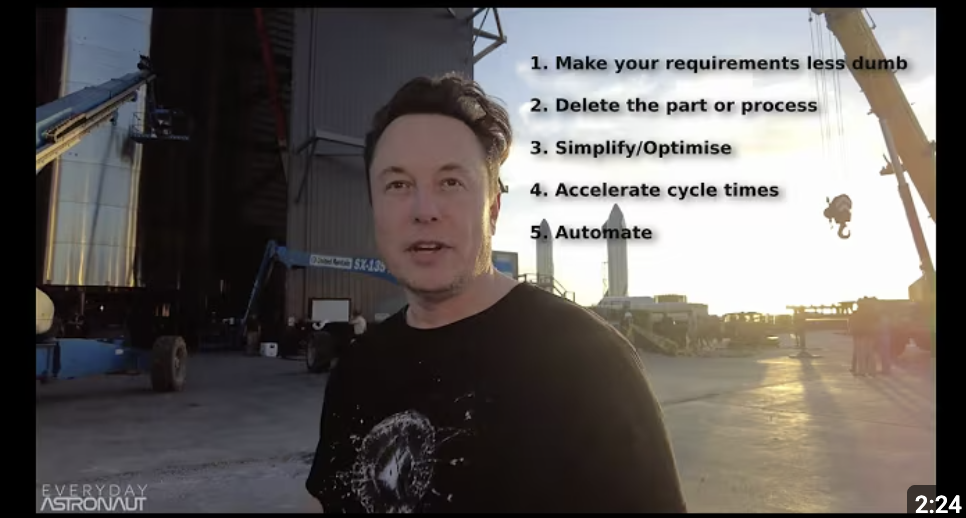
That was when I learned the third lesson: do not automate something before you understand its full workflow. This echoes what Elon Musk has said before: automation should always be the last step. First, you manually verify whether every step is necessary, and that also helps you understand the relationships between different parts of the process. We automated content generation too early, and the result was inconsistent quality.
So we spent more time improving the product and introduced a human review mechanism. To add humans back into the workflow, we also rewrote the entire product backend. Even though we took some detours, the output quality has improved a lot, and we have learned a great deal from collaborating with AI.
Related: automation should come last
Lesson 4: Make One Channel Work
Beyond product changes, we also tried many things on the customer acquisition side. After reaching out to everyone around us, we had to start finding cold customers. From feedback from our early customers and from our own market research, we knew our target customers were B2B startup founders between seed and Series A, especially vertical SaaS founders.
The next question was: how do we reach them?
We tried cold emails, LinkedIn cold messages, Reddit posts, Twitter, searching forums for keywords, entering founder Slack communities, attending in-person founder events, and more.
Because we did not know which channel would work at the beginning, and because we badly needed new cold customers, we could only keep trying things randomly. Along the way, we accidentally got one cold customer from a Reddit post and booked some sales meetings by DMing people under specific Twitter posts. But most other channels did not produce much. Not only did they not bring customers; often they did not even bring meetings. Cold outreach response rates were especially scary.
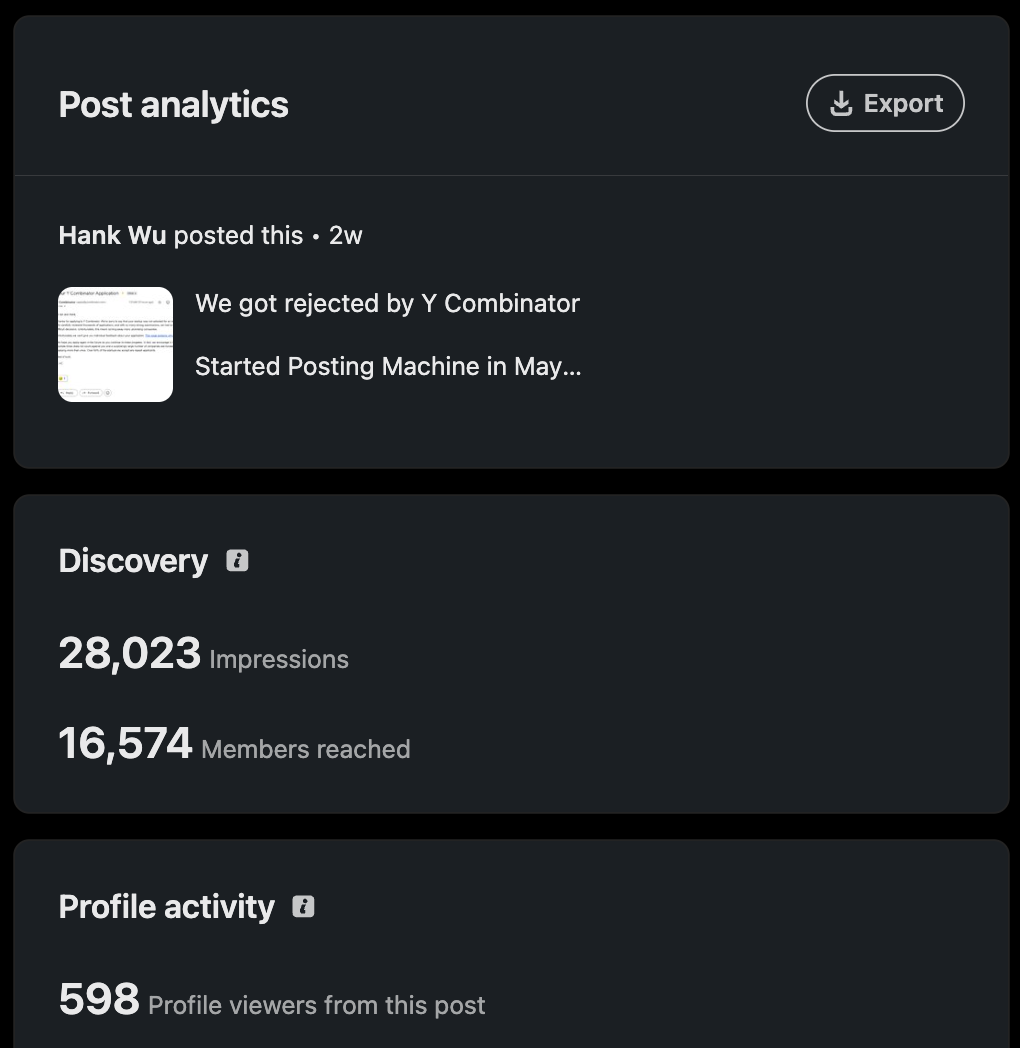
The turning point came after I posted about our YC rejection on LinkedIn. Before that, I had been posting consistently, but mostly from the perspective of testing our own product. And during the product rebuild, I had stopped posting for a while. But this YC rejection post performed extremely well. That single post brought almost 30,000 impressions, more than 300 connection invites, and after filtering for ICPs, I booked around 10 sales meetings through warm outreach and closed some of them.
And it was not only that post. Afterward, I became much more intentional about my LinkedIn content. Through different angles, topics, and content strategy mixes, my LinkedIn reach and conversion kept improving. Many posts brought potential customer leads. This also fit exactly with the reason we started building this product: helping founders turn LinkedIn into a social selling channel by creating high-quality posts, generating engagement, identifying ICPs, and booking meetings.
This channel’s success gave us the fourth lesson learned: startups have too many things they can try, so you need to find a way to focus on one or two of them. The same is true for go-to-market. It is better to make one or two channels work and scale them than to do ten channels at once without being good at any of them. Redundant attempts are not only ineffective; they are emotionally exhausting. You start to feel powerless, as if you are working very hard but getting no results.
Further reading: How to Get Your First 10 Customers by YC
We Are Not Just Building a Posting Tool
Beyond sales, this successful attempt also gave us a lot to rethink about the product direction. Once we can consistently help users create high-quality posts, the next step is helping them analyze engagement and identify ICPs to reach out to. It turns out that warm outreach through LinkedIn content can have response rates five to ten times higher than cold outreach.
We adjusted our end goal. What we can help customers achieve is not just posting. We are trying to build a new category. Every B2B founder knows how important an accurate sales list is, but list generation has become standardized work, and cold outbound is just a numbers game. If we can help founders generate accurate, high-response-rate warm ICP lists through LinkedIn content, that opens up a new sales channel. We are not simply building a LinkedIn posting tool. We are building an end-to-end social selling solution on LinkedIn.
We are still at a very early stage, but we believe the market demand is real, and no one has yet figured out how to consistently generate high-quality sales lists through content. As AI continues to develop, we believe future customer acquisition channels will increasingly narrow toward AI chat and social media. AI ranking systems are also giving more weight to social media exposure. We think the next explosion in B2B sales will be in social selling, just like cold emails three years ago, Google Ads five years ago, and SEO ten years ago. The key is to capture the advantage before the window closes.
Where We Are Now, and What Comes Next
Honestly, we are still not growing fast enough. Since we truly started this project in May, a little more than a month has passed. We have six paying customers and two design partners, both founders with more than 10,000 LinkedIn followers. We still want to grow faster. Right now, one blocker is actually our time, because both Ian and I are still doing this part-time.
Our current thinking is that if we can get ten customers and retain them for three months, we can prove this is a promising idea and that customers are willing to keep paying for it. After that, we would like to raise an angel round, move to the Bay Area, and work on this full-time. We are still some distance away from that goal, but it is not impossible. Over the past two years, seeing many Taiwanese founders get into YC has made me feel that Taiwan’s startup ecosystem is becoming more energetic. It also reminds me that paths are made by walking them. Keep experimenting, learning, improving, and adjusting along the way.
Set the goal. Give it everything.
中文版本
Posting Machine 創業筆記
從四月中決定和 Ian 一起做 side project 到現在也兩個月了,差不多是時候紀錄一下這段時間的心得。
我們是怎麼認識的
我和 Ian 其實兩年前就透過 YC Co-founder Match 認識了,但當時我們都比較像為了未來做準備,而不是當下就要創業,他那時候在 Heptabase 當工程師,而我還在 GoFreight 做 go to market,儘管我們沒有當下就組隊創業,但我們從那時就一直保持聯絡,定時都會 catch up,所以在今年四月決定一起做些什麼的時候也已經認識一陣子了。
起心動念
起心動念是聽到一個 founder 朋友有這個困擾:每個 B2B founder 都知道 LinkedIn 是個很重要的 channel,大家都想經營好,不論是 build personal branding 或是 converting sales,但不外乎:沒時間、沒發文點子、或不確定發什麼會中。
但其實 founder 有非常多早就 ready 的 context 是很適合做成 content 的,不論是自己過去的成長故事、有趣的個人經歷、或是日常和客戶會議裡的 insight,其實都是很寶貴很適合發文的題材。
於是我們從用戶的 real context 出發,結合我們幫用戶量身訂作的 content strategy 生成 LinkedIn posts,目標是以後 founder 只要花 5 到 10 分鐘 approve or reject 我們生成的點子和貼文,就不用再煩惱接下來一個月 when to post 跟 what to post。
為什麼我們覺得這值得做
我記得我們第一個針對這個題目的討論是四月我從倫敦回台灣的時候,我們討論得非常起勁,因為我剛好過去和不同 founders 都工作過一段時間,從 VC、CEO 特助、Chief of Staff、到 Founder Associate,這些職位都讓我長時間和創辦人相處,我太知道他們的時間有多寶貴,並且傾向使用哪種形式的 software,除此之外我過去也涉獵幾乎每個 B2B go to market 的管道,我太知道不同管道會遇到的問題跟 LinkedIn 有多少潛力,我認為 LinkedIn 是目前少數還沒 saturated 的管道之一。
在激烈討論後我們兩個都同意這是值得試試的題目,與此同時我們也分別把這個點子跟身邊的 founder 朋友驗證,看看是不是真的有市場,沒想到我們兩個分別加起來十幾個 discovery calls 得到的反饋非常好,之後在我去日本玩的時候,Ian 就一個人把 MVP 做出來了,看來是時候可以賣了。
Lesson 1:人脈是有複利的
五月從日本回倫敦後,開始瘋狂約 sales meeting,從身邊 network 開始,我大概發了 30 則訊息吧,不論是直接問有沒有興趣或是問 referrals,其實這件事說來也不難,就是臉皮厚一點,並且習慣無聲和拒絕。這部分我也很熟悉了,在找倫敦工作時跟落地倫敦後,我一直都有在約 coffee chat,被拒絕也是家常便飯。
很幸運地,一路上累積了不少 mentors 跟朋友,在這種時候就派上用場了,這邊引出第一個 lesson learnt:擁有一個自己的人脈網路在創業時格外有幫助,但這仰賴時間跟個人信用的累積,必須是事前就建立起來不求回報的人脈,當你需要幫忙時才最有可能伸出援手,就好比金融資產會隨著時間產生複利,人脈亦然。
在瘋狂發送訊息後(抱歉我的朋友們),約到了一些 sales call,並且在五月第二個禮拜順利成交第一單和第二單,直到現在還是無法忘記第一次看到客戶聽完 pitch,點頭說:「好,我們試試看」的情境,在擁有第一個付費客戶之後,怎麼真的創造價值幫上我們的客戶就成了無庸置疑的 north star metrics。
Lesson 2:Sales 的核心是關注客戶的問題,不是你的 solution
在做 sales call 的過程中,第二個 lesson learnt 是:不要想著你的 solutions,關注客戶的問題。我們要做的是幫助客戶解決問題,所以其實大部分的時間都是花在了解客戶的問題,而不是一直介紹自己的解決方案,最終目標是透過這筆交易達成雙贏,而不是從客戶身上騙錢,optimize for long-term relationship not short-term profit。
Lesson 3:不要在搞清楚流程之前自動化
獲得前兩個客戶之後,我們發現之前短時間衝刺出來的 MVP 不夠滿足客戶的要求,我們想要自動化 context to content 這段,於是我們決定把底層重構,接入更多 context,沒想到改完的產品竟然比原本更難用,花了一堆時間接入更多 context 反而造成 overfit,寫出來的 content 慘不忍睹,不是太過於強調某些 context,不然就是前後邏輯不通順。
這時學到了第三個 lesson learnt:不要在搞清楚一件事的完整流程之前自動化它,這呼應 Elon Musk 之前提到的,自動化永遠是最後一步,首先是先手動驗證是否每個步驟都有存在的必要,並且也能幫助你搞清楚不同環節之間的關聯,我們太早自動化生成 content 的方式,反而產生質量不一的內容。
於是我們花了一些時間再把產品改良,並且引入人工審核的機制,而為了把人類加回這個工作流,我們也重寫了整個產品後台,儘管走了些彎路,但現在文章的產出品質大幅提升,我們也透過和 AI 協作的過程收穫很多。
延伸影片:automation should come last
Lesson 4:把一個 channel 做好
除了產品之外的調整,在如何獲得客戶上也做了非常多嘗試,在聯絡完身邊所有人後,我們必須陌生開發客戶了,我們從先前簽下的幾名客戶的回饋和對自己產品市場的調研,知道我們的目標客戶是種子輪到 A 輪間的 B2B 新創創辦人,尤其是 vertical SaaS 更是我們的目標。
但接下來的問題變成如何接觸他們?
我們嘗試過 cold emails、LinkedIn cold messages、Reddit 發文、Twitter、到各大論壇搜尋關鍵字找人、潛入各創辦人的 Slack community、參加創辦人間的實體活動……等等。
由於我們剛開始做不知道什麼渠道會成功,並且非常缺新的陌生客戶,於是我們只能一直亂試,過程中有歪打正著透過發 Reddit 文獲得一個陌生客戶,並且透過私訊特定 Twitter 貼文下的人獲得一些 sales meeting,但其他管道大部分都沒什麼收穫,不只是沒有客戶連會議都約不到,尤其 cold outreach 的回覆率更是低的嚇人。
事情的轉機在我發了 YC rejection 的 LinkedIn 文 之後,在這之前我也都有一直發文,但都是抱著測試自己產品的角度,而且中間經歷產品重構,我的發文也停滯了一段時間,但這篇 YC rejection 的文章帶來的成效非常驚人,光這篇文帶來將近 30,000 的曝光,大概 300 多個 connection invites,並且我從中篩選出 ICP 去 warm outreach 約到了約 10 個 sales meetings,並順利從中成交一些。
並且也不只這則貼文,後續我更用心經營自己的 LinkedIn 內容,透過不同角度、選題、比例的內容策略,我的 LinkedIn 貼文觸及和轉換越來越好,很多篇都有給我帶來潛在客戶的聯繫,而這也正好符合我們做這個產品的初衷,協助 founder 將 LinkedIn 變成一個 social selling 的銷售管道,透過產出高質量的貼文,產生 engagement,從中聯絡 ICP 並約到會議。
這個管道的成功也給我們帶來了第四個 lesson learnt:新創可以做的嘗試真的太多了,要想辦法專注在其中一兩件事上,go to market 也是,先把一兩個 channel 做好做大,比一股腦做十個 channel 但沒一個專精要強得多。那些冗餘的嘗試不僅很難帶來成效,也很消磨心力,你會有一種你明明很努力但卻沒有成績的無力感。
延伸閱讀:How to Get Your First 10 Customers by YC
我們在做的,不只是發文工具
除了 sales side,這次成功的嘗試也給我們產品方向帶來很多反思,原來當我們能夠持續幫用戶產生高品質的貼文之後,下一步是幫助他們分析 engagement 並從中找出 ICP 進行聯繫,原來這種透過 LinkedIn 發文認識你的 warm outreach 能夠有比 cold outreach 高五到十倍的回覆率。
我們調整了我們的 end goal,我們能夠幫客戶達到的目標不只是發文,我們是在打造一個全新的賽道,每個 B2B founder 都知道準確的 sales list 有多重要,但生成名單已經變成制式作業,cold outbound 也只是 numbers game,如果我們有辦法透過產出 LinkedIn content 幫 founders 帶來精準且有高回覆率的 warm ICP list,這會開闢一個新的 sales channel,我們在做的不是單純的 LinkedIn 發文,而是 end to end 的 social selling solutions on LinkedIn。
目前我們還在很早期的階段,但我們認為這個市場的需求真實存在,並且市面上還沒有人 figure out 怎麼穩定地透過 content 產生高品質的 sales list,我們相信隨著 AI 繼續發展,未來獲客管道只剩下 AI chat 和 social media,而 AI ranking 現在也不斷調高 social media 曝光的權重,我們認為下一個 B2B sales 的爆發就在 social selling,就好像三年前的 cold emails、五年前的 Google Ads、十年前的 SEO,要趁紅利期前獲得先機。
現在的位置,以及下一步
平心而論我們成長的速度還是不夠快,從五月真正開始這個 project,到現在過去一個多月,獲得六個付費客戶和兩個 design partners(都是 LinkedIn followers 大於一萬的 founders),我們還想成長的更快,現在其中一個 blocker 其實是我和 Ian 的時間,因為我們都是 part time 在做這個題目。
目前的想法是如果能獲得十個客戶並 retain them for three months,就能夠證明這是個有潛力且客戶願意持續付費的題目,之後會想募個天使輪,搬到灣區全職投入這個題目,儘管現在離那個目標還有些距離,但並不是不可能,這兩年看到很多台灣 founder 入選 YC,覺得台灣創業圈越來越有活力了,也勉勵自己路永遠是人走出來的,繼續試錯學習進步,滾動式調整。
設定目標,全力以赴!
- Tags:
- Startup
- Entrepreneurship
- Founders